Documents Needed to Ship to Ivory Coast: Commercial Invoice and Packing List Checklist
Sending a package overseas is exciting, but paperwork is where many shipments go wrong. If you are shipping to ivory coast for the first time, you may be surprised by how closely customs officers look at your documents. A missing invoice or a vague item description can leave a parcel sitting in a warehouse for weeks, and storage fees can add up quickly.
The good news is that the paperwork is manageable once you know what is required. This guide walks you through every document you are likely to need, explains what each one should contain, and shares practical tips to keep your shipment moving. Whether you are sending a gift box to family or exporting goods for your business, use this checklist before you seal the box.
Why Shipping Documents Matter
Every international shipment passes through two customs systems: the United States on the export side and Ivory Coast on the import side. Customs officers use your paperwork to decide what the goods are, what they are worth, and how much duty and tax the recipient owes. When your documents are clear and consistent, clearance is usually smooth. When details are missing or do not match the package, officers may hold the shipment for inspection, ask for more information, or assess higher charges.
Accurate documents also protect you. If a parcel is lost or damaged, a proper invoice proves the value of the contents, which makes a claim much easier to file and win.
The Commercial Invoice: Your Most Important Document
The commercial invoice is the main document customs uses to determine the value and classification of your goods. Even when you are sending a gift or personal items, you should include one, because it tells officers exactly what is inside and why. A complete commercial invoice should include:
- The full name, address, and phone number of the sender and the recipient
- The invoice date and an invoice number
- A detailed description of every item, such as "men's cotton T-shirts" instead of just "clothes"
- The quantity, unit price, and total value of each item in US dollars
- The country where each item was made
- The Harmonized System (HS) code for each product, when available
- The reason for export, such as sale, gift, sample, repair, or personal effects
- The shipping terms for commercial sales, such as DAP or DDP, so everyone knows who pays duties
- The signature of the sender and the date
Honesty matters here. Declaring a value that is too low may seem like a way to reduce duties, but it can trigger delays, fines, or seizure of the goods. Always declare the real value, and keep your receipts in case customs asks for proof.
Print at least three copies. Place one in a clear pouch on the outside of the box, keep one for your records, and send a digital copy to the recipient so they can show it to customs if needed.
The Packing List: Proof of What Is in Every Box
While the invoice focuses on value, the packing list focuses on the physical details of your shipment. It helps customs officers check the contents quickly, and it helps the carrier confirm that nothing is missing at each stage of the journey. A good packing list includes:-
- The number of boxes or pallets in the shipment
- A list of what is inside each box, with quantities
- The weight of each package, in pounds and kilograms
- The dimensions of each package
- Any shipping marks or box numbers written on the outside
The most important rule is consistency. The items, quantities, and weights on the packing list must match the commercial invoice and the actual contents. If an officer opens a box and finds something that is not listed, the whole shipment may be flagged for a closer inspection.
For multiple boxes, number each one clearly, such as "Box 1 of 4," and tie that numbering to the list. This small habit saves a lot of time during inspection.
Air Waybill or Bill of Lading
Every shipment also needs a transport document. For air and express courier shipments, this is the air waybill, which acts as the contract between you and the carrier and carries the tracking number. For ocean freight, the equivalent is the bill of lading, which also serves as a receipt for the goods and is often needed to release them at the destination.
Your shipping provider normally creates these documents for you, but you should check every detail. Names, addresses, and phone numbers must be spelled correctly, and the description of the goods must match your invoice. A mistake here can cause the recipient to be unable to claim the cargo.
Other Documents You May Need
Depending on what you are sending and who you are sending it to, additional paperwork may apply:
- Certificate of origin: Sometimes requested for commercial goods to prove where products were made, which can affect duty rates.
- Export filing: In the United States, shipments valued over $2,500 per Schedule B commodity code, or goods that require a license, generally need an electronic export filing.
- Importer details: Commercial imports into Ivory Coast usually require the receiving business to be registered, and the recipient may need to provide a tax identification number.
- Pre-arrival documents: For some sea shipments, Ivorian authorities may require a cargo tracking note or similar pre-arrival paperwork. Confirm the current requirement with your forwarder before you ship.
- Permits and certificates: Food, plants, medicines, and some electronics or batteries may need special permits or health certificates, and some items are restricted or prohibited entirely.
- Recipient identification: Customs may ask the person collecting a package to show a valid ID.
Rules change, so always verify the latest requirements with your shipping company or the Ivorian customs authority before sending anything valuable or regulated.
Choosing a Shipping Method and What It Means for Your Paperwork
Your choice of shipping method affects both your costs and your documents. Express courier services are fast, usually delivering within a few business days, and they rely mainly on the commercial invoice and the air waybill. They suit parcels, documents, and urgent gifts.
Ocean freight takes longer, often six to eight weeks, but it is far more economical for heavy or bulky cargo. If you are looking for the cheapest way to ship freight, sea shipping is usually the answer, although it requires a bill of lading, a detailed packing list, and extra planning time for port handling.
If you are comparing providers, a dependable shipping service from US locations should be able to explain exactly which documents your cargo needs, prepare the labels, and arrange pickup, so you do not have to figure out every form on your own.
Most ocean cargo arrives through the Port of Abidjan, the country's main commercial hub. When you are shipping to Abidjan, make sure the recipient's phone number and delivery address are complete and correct, because the carrier and the clearing agent will need to reach them quickly when the cargo lands.
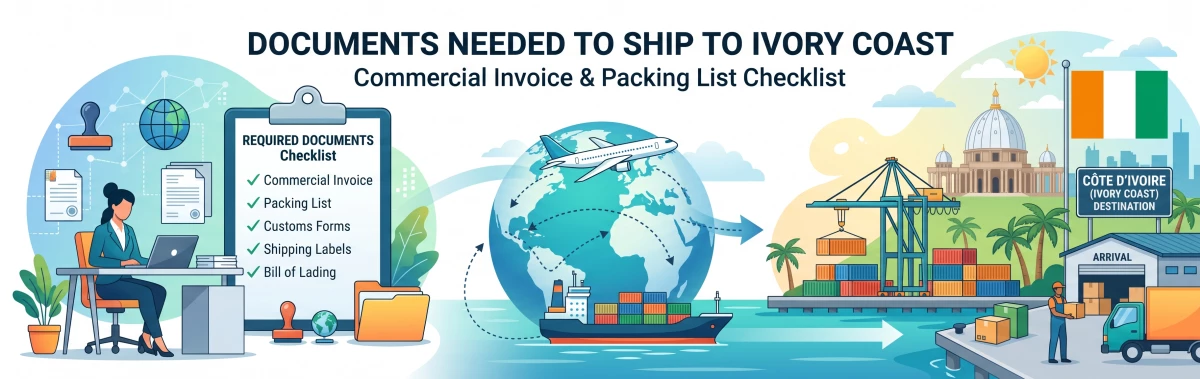
Quick Document Checklist
Before your shipment leaves, confirm that you have:
- A signed commercial invoice with accurate descriptions and values
- A packing list that matches the invoice and the box contents
- An air waybill or bill of lading from your carrier
- Any export filing, certificate of origin, or permits that apply
- Recipient name, address, phone number, and ID details ready
- Digital copies of everything, saved and shared with the recipient
Common Mistakes to Avoid
Most customs delays come from small, avoidable errors. Watch out for these:
- Vague descriptions. Words like "gifts," "stuff," or "parts" are not accepted. Be specific about what each item is and what it is made of.
- Mismatched paperwork. If the invoice says five items and the packing list says six, expect questions.
- Undervaluing goods. Customs officers know typical prices. A suspiciously low value can lead to delays or a reassessment.
- Incomplete contact details. A missing phone number can leave a parcel stuck because nobody can confirm delivery.
- Packing prohibited items. Check restricted lists before you pack, since one banned item can hold up the entire box.
- Unprepared recipients. Let the receiver know to expect the package, keep their ID ready, and be prepared to pay any duties and taxes.
Conclusion
Shipping documents may not be the most exciting part of sending a package, but they are the key to a fast, stress free delivery. Prepare a complete commercial invoice, a matching packing list, and the correct transport document, add any permits or filings your goods require, and double check every detail before pickup. A few extra minutes of preparation can save you weeks of delay and unexpected fees.
Ready to send your package without the paperwork headaches? Zion Shipping makes international shipping simple, with competitive rates, trusted carriers, real time tracking, and a team that can guide you through the documents you need. Get an instant quote today at zionshipping.com/get-quote, call (855) 900-9466, or message us on WhatsApp, and let Zion Shipping get your shipment to Ivory Coast safely.
Also Read: 10 Common Mistakes When Shipping to the Dominican Republic
Frequently Asked Questions
1. What documents do I need to ship a package to Ivory Coast?
At a minimum, you need a commercial invoice and a packing list, along with the air waybill or bill of lading from your carrier. Depending on the contents, you may also need permits, a certificate of origin, or an export filing.
2. Do I need a commercial invoice for personal items or gifts?
Yes. Even when goods are not for sale, customs still needs to know what is inside and what it is worth. Mark the reason for export as a gift or personal effects and list a fair value for each item.
3. What is the difference between a commercial invoice and a packing list?
The commercial invoice shows the value, description, and terms of sale for your goods, and customs uses it to calculate duties and taxes. The packing list shows the physical details, such as the number of boxes, contents, weights, and dimensions, and it is used to verify the shipment during inspection.
4. Who pays customs duties and taxes on shipments to Ivory Coast?
Usually the recipient pays duties and taxes when the package arrives, based on the declared value and the type of goods. If you want the sender to cover these charges, you can ask your carrier about delivered duty paid options.
5. What happens if my shipping documents are incorrect or missing?
Your shipment may be held at customs, inspected, returned, or charged extra fees. Correcting the paperwork quickly and staying in touch with your shipping provider usually gets the package moving again, but prevention is always cheaper than a fix.