
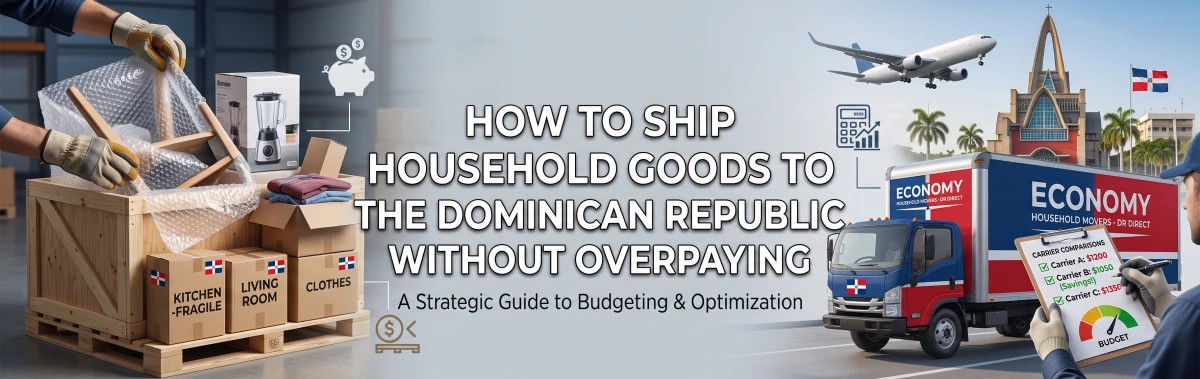
How to Ship Household Goods to the Dominican Republic Without Overpaying
Moving your life across water is never simple. Between coordinating pickup dates, figuring out what actually fits in a barrel, and trying to make sense of customs paperwork written for logistics professionals rather than everyday families, it is easy to end up paying far more than you should. Whether you are relocating permanently, furnishing a vacation home, or sending furniture to a family member, the good news is that overpaying is almost always avoidable once you understand how pricing actually works and where the hidden costs tend to hide.
This guide walks through the practical steps that keep your shipping costs under control, from choosing the right method to packing efficiently and picking a partner who will not surprise you with fees after your goods have already left the dock.
Understanding What Actually Drives Shipping Costs
Most people assume that price is simply a matter of weight, but that is only part of the picture. Carriers price shipments based on a combination of weight, dimensional volume, and destination, and for many household items volume matters more than weight does. A large but lightweight item, like a mattress or a stack of empty suitcases, can cost more to ship than a dense box of books simply because it takes up more room in the container.
Season also plays a bigger role than most first-time shippers expect. Rates climb in the weeks before major holidays and during hurricane season, when demand rises, and vessel space becomes limited. If your move has any flexibility at all, shipping a few weeks outside of peak periods can meaningfully lower your total cost.
Finally, service level changes the price dramatically. Express air delivery might get your goods there in a matter of days, but ocean freight for the same load can cost a fraction of that price if you are willing to wait two to four weeks instead.
Choosing Between Air and Ocean Freight
For most household goods shipments, ocean transport is the more economical choice. If you are arranging freight to dominican republic for furniture, appliances, or a full household of belongings, ocean shipping typically costs far less per pound than air, even though it takes longer to arrive. Air freight makes sense when you need something urgently or when the shipment is small enough that the price difference barely matters.
A useful rule of thumb is to reserve air shipping for items you cannot be without, like important documents, medication, or a small box of essentials you will need in your first week, and let ocean freight handle the bulk of your move. Mixing the two service levels intentionally, rather than defaulting to whichever option feels fastest, is one of the simplest ways to control your total spend.
Consolidation and Sharing Container Space
If your shipment does not fill an entire container, you are likely a candidate for consolidated freight, sometimes called less than container load service. Instead of paying for a whole container, your goods share space with other shipments heading to the same destination, and you only pay for the portion of the container your items actually occupy.
This single decision often produces the biggest savings of the entire process. A family shipping a few barrels and a handful of boxes almost never needs a dedicated container, yet many first time shippers book one anyway simply because they do not know consolidation exists. Ask directly whether your shipment qualifies before committing to a rate.
Packing Smart to Avoid Paying for Empty Space
Because so much of shipping pricing is tied to volume, how you pack matters just as much as what you pack. Dense, tightly packed boxes and barrels cost less per item than loosely packed ones with wasted air space inside them. Before sealing anything, fill every gap with soft items like clothing, towels, or linens rather than shipping them separately.
If your plan is to buy and ship from us to dominican republic, whether that means purchasing furniture, appliances, or building materials specifically to send overseas, try to buy items that disassemble or nest inside one another. A dining table with removable legs or a bed frame that breaks down into flat panels takes up dramatically less volume than the same piece shipped fully assembled, and that difference shows up directly on your invoice.
It also helps to consolidate smaller errands into a single shipment rather than sending several small parcels over time. If your goal is simply to send a box to the Dominican Republic every few months for a family member, combining a few months of items into one larger shipment is almost always cheaper than paying separate handling and processing fees each time.
Getting the Documentation Right the First Time
Customs delays are one of the most common and most avoidable sources of unexpected cost. A shipment held at customs because of missing paperwork can accrue storage fees while it waits to be released, and those fees add up quickly. Before your goods ship, make sure you have an accurate packing list, a clear description of every item and its value, and the recipient's contact information and identification details, since Dominican customs may request a national ID or tax number for certain entries.
Being honest and specific about item values also protects you. Underdeclaring value to reduce duties can backfire badly, resulting in fines or seized goods, while accurate declarations move through inspection far more smoothly and predictably.
Timing Your Shipment Around Seasonal Demand
As mentioned earlier, timing has a real effect on price. If you are not working against a hard deadline, avoid shipping in the final weeks before Christmas, when demand from both individuals and businesses surges, and rates rise accordingly. Hurricane season can also disrupt schedules and pricing, so building a little buffer time into your plans gives you more flexibility to book when rates are lower rather than when they are highest.
Avoiding Common Fees That Catch People Off Guard
Even careful shippers sometimes get surprised by charges they did not anticipate. Storage fees can accrue if a shipment sits at a port or warehouse waiting for pickup, so confirm delivery windows in advance rather than assuming someone will be home whenever the truck happens to arrive. Insurance is another area worth planning for rather than skipping. Basic coverage included in a shipping rate is often minimal, and adding proper coverage for higher value items like electronics or appliances is usually inexpensive relative to the protection it provides.
It also pays to ask whether duties and taxes are included in your quoted price or billed separately once the shipment reaches the Dominican Republic. Some providers quote an attractive base rate that does not include destination charges, which can leave you facing an unexpected bill right before delivery. Requesting a single all-inclusive number from the start removes this guesswork entirely and makes it much easier to compare providers fairly.
Working With a Reliable Shipping Partner
Perhaps the single biggest factor in avoiding overpayment is choosing a company that is transparent from the start. Some providers advertise low base rates and then add fuel surcharges, handling fees, or customs processing charges once your shipment is already committed. Others quote a flat, all-inclusive rate so you know your total cost before you ever hand over a box.
If you are looking into parcel delivery to the dominican republic for the first time, ask for a full breakdown of the quote in writing, including any fees that might apply at the destination end. A reputable partner will walk you through the numbers clearly rather than leaving you to discover extra charges after your goods have already shipped.
Zion Shipping offers upfront, all-inclusive pricing on both air and ocean service, with consolidation options for smaller loads, live rate comparisons at checkout, and a team that handles pickup, customs clearance, and door-to-door delivery in the Dominican Republic. Get an instant quote at Zion Shipping today and see exactly what your household goods shipment will cost before you commit to a thing.
Also Read: How to Buy and Ship Goods from the US to the Dominican Republic with Ease
Frequently Asked Questions
Q1. Is ocean freight always cheaper than air freight to the Dominican Republic?
In most cases, yes, especially for heavier or bulkier household items. Air freight can still be worth it for small, urgent, or time-sensitive shipments where the speed outweighs the extra cost.
Q2. How can I tell if my shipment qualifies for consolidated service?
If your goods do not fill a full container on their own, you likely qualify. A shipping provider can tell you quickly based on the total volume and weight of your items.
Q3. Does packing method really affect my final price?
Yes. Since many carriers price based on volume as well as weight, tightly packed boxes and barrels with minimal space typically cost less to ship than loosely packed ones.
Q4. What documents do I need to avoid customs delays?
A detailed packing list, accurate item values, and the recipient's identification information are the most important pieces. Missing or vague paperwork is one of the most common causes of delay and added storage fees.
Q5. When is the cheapest time of year to ship household goods to the Dominican Republic?
Outside of major holidays and hurricane season, when demand is lower and vessel space is more available. Booking a few weeks in advance during these quieter periods usually results in the best rates.