
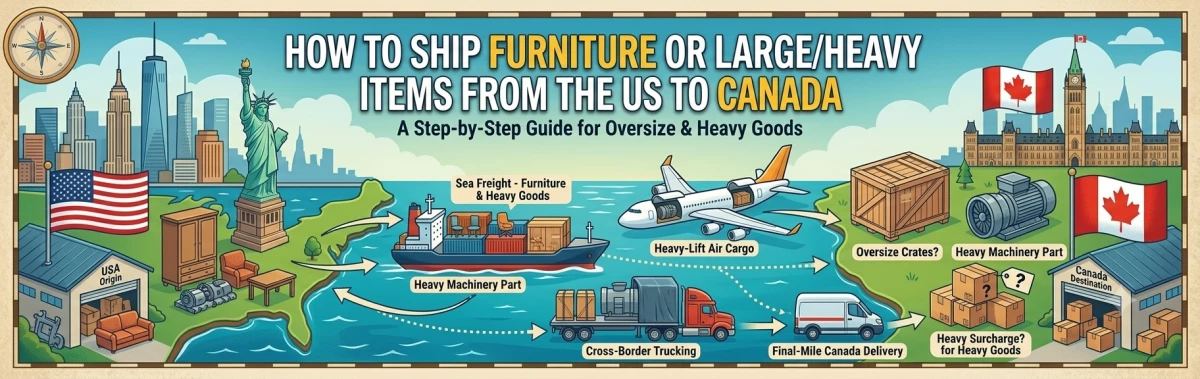
How to Ship Furniture or Large/Heavy Items from the US to Canada
Shipping a couch, a dining table, a treadmill, or a pallet of equipment across the border is a different challenge than mailing a small parcel. The size and weight change everything: the carriers you can use, the paperwork you need, the cost you should expect, and how the item actually gets from a US address to a Canadian doorstep. Whether you bought furniture from a US retailer, are relocating personal belongings, or run a business that needs to move bulky inventory north, understanding the process upfront saves you from delays, surprise fees, and damaged goods.
This guide walks through everything you need to know about moving large and heavy items across the border, from choosing the right shipping method to handling customs and protecting your item along the way.
Why Large and Heavy Shipments Work Differently
Small parcel carriers like USPS, UPS, and FedEx are built around standard package dimensions and weight limits. Once an item exceeds those limits, or simply does not fit safely in a box, it moves into a different category of logistics entirely. Furniture, appliances, exercise equipment, and similar items typically need to travel by freight, which means different pricing models, different handling requirements, and often a longer planning window.
Freight shipping calculates cost differently than parcel shipping. Instead of just weight, carriers also factor in dimensional weight, which accounts for how much space an item takes up relative to its actual weight. A lightweight but bulky item, like a sectional sofa, can cost more to ship than a smaller item that weighs the same. Understanding this distinction early helps you budget accurately and avoid sticker shock when the quote comes back.
Choosing the Right Shipping Method
There are a few common ways to move large items from the US into Canada, and the right one depends on the size of your shipment, your timeline, and your budget.
For a single large item, such as one piece of furniture or one appliance, LTL freight, short for less-than-truckload, is usually the most practical option. Your item shares space in a truck with other shipments, which keeps costs lower than booking an entire trailer. LTL is a good fit for individual movers, small businesses, and anyone shipping a handful of large items rather than a full container's worth of goods.
If you are moving a large volume of furniture or heavy equipment, full truckload (FTL) shipping might make more financial sense. You pay for the entire truck regardless of how much space you actually use, but for bigger loads, the per-item cost often works out lower than LTL.
White glove delivery services exist for higher-value or fragile items where you want assistance with assembly, placement inside the home, or removal of old furniture. This option costs more but reduces the risk of damage during the final delivery stage, which matters most for items like glass furniture, pianos, or high-end electronics.
For business shipments that involve repeat large-item delivery from the US to Canada, working with a logistics partner who can manage carrier selection, route planning, and customs documentation on your behalf often ends up being more cost-effective than trying to coordinate each shipment independently.
Preparing Your Item for the Journey
Large and heavy items face more handling points than a small parcel, and each transfer is an opportunity for damage if the item is not properly prepared.
Disassembling furniture where possible reduces both shipping cost and risk. A bed frame, table, or bookshelf that breaks down into flat panels takes up less space, fits more securely in a crate or pallet, and is less likely to shift during transit. Keep all hardware, screws, and assembly instructions together in a labeled bag taped securely to one of the main pieces.
Wrapping and padding matter even more for heavy items than for small parcels because the forces involved during loading and unloading are greater. Furniture blankets, stretch wrap, corner protectors, and edge guards help prevent scuffing, scratching, and structural damage. For anything with glass, mirrors, or delicate finishes, additional rigid protection, such as cardboard sheeting or a custom crate, is worth the extra cost.
Palletizing is standard practice for freight shipments. Securing your item to a pallet with industrial shrink wrap or strapping keeps it stable inside the truck and makes it easier for forklift operators to move safely at each transfer point. If your shipping provider does not handle palletizing for you, many local packing and freight supply stores can do this for a reasonable fee.
Labeling should be clear, durable, and placed in multiple visible spots on the item or crate. Include the sender's and receiver's full contact information, and make sure any "this side up" or "fragile" markings are visible from more than one angle, since the item may be loaded in different orientations during transit.
Customs Considerations for Large Shipments
Crossing the border with a large item involves the same customs principles as a smaller package, but the stakes are higher because the value and weight typically attract more scrutiny.
You will generally need a commercial invoice or bill of sale that clearly states what the item is, its value, the country where it was manufactured, and the reason for the shipment, whether that is a personal purchase, a gift, or a commercial sale. Vague descriptions like "furniture" or "equipment" can trigger delays, so be specific: "solid wood dining table, six chairs" gives customs officials what they need to process your shipment efficiently.
Duties and taxes for large items are calculated based on the declared value, the type of goods, and where the item was made. If the item qualifies under the USMCA because it was manufactured in the United States, it may be eligible for reduced or eliminated duties, but you will need to provide proof of origin to claim that benefit. Canada also applies GST, and depending on the destination province, you may also see PST or HST added to the total cost.
Be aware that some large items fall into regulated categories. Furniture made with certain woods, upholstered items, and electronics with embedded batteries can sometimes require additional documentation or inspection. Checking with your carrier or logistics provider before shipping prevents a shipment from being held at the border while you scramble to produce missing paperwork.
Estimating Costs for Large or Heavy Shipments
Cost is usually the first question anyone asks when planning a delivery from USA to Canada for furniture or bulky goods, and it is also the hardest to estimate without a specific quote, because so many variables are involved.
Distance plays a role, since a shipment from a US city near the border will generally cost less to move than one originating much farther away. Weight and dimensions matter just as much, since freight carriers price based on a combination of both, not weight alone. The shipping method you choose changes the price significantly: LTL is typically more affordable than white glove service, and standard ground freight is cheaper than expedited options.
Insurance is worth factoring into your budget as well. Furniture and large items are more prone to transit damage than small, well-packed parcels, simply because of their size and the number of handling points involved. Many freight carriers offer basic liability coverage by default, but it is often minimal. Purchasing additional coverage for higher-value items protects you financially if something goes wrong.
It also helps to request multiple quotes before booking. Rates for shipping from the United States to Canada can vary noticeably between providers depending on their carrier relationships, route efficiency, and whether they specialize in freight versus standard parcel delivery. A provider experienced specifically in cross-border freight will often be able to offer a more competitive and predictable rate than a general parcel service trying to accommodate an oversized item.
Delivery Timelines and What to Expect
Large item shipments typically move slower than small parcels, both because freight schedules are less frequent than daily parcel routes and because customs processing for higher-value goods can take longer. Depending on the carrier and service level you choose, transit time for buy and ship from us to canada furniture orders commonly ranges from several days to a couple of weeks.
Someone usually needs to be available to receive the shipment, especially for white glove or curbside delivery services, since large items often cannot simply be left at the door the way a small parcel can. Confirming delivery logistics ahead of time, including whether the carrier offers inside delivery or curbside drop-off only, prevents confusion on delivery day.
Tracking is available for most freight shipments, though updates may be less frequent than what you would see with a small parcel carrier. If you do not see movement for a day or two, this is often normal for freight, particularly while the shipment passes through a sorting terminal or customs clearance.
Common Mistakes to Avoid
Underestimating dimensional weight is one of the most frequent and costly errors. Always confirm the dimensional weight calculation with your carrier before booking, especially for bulky but lightweight items.
Skipping proper crating or palletizing for fragile or high-value items often leads to damage claims that take time to resolve and may not be fully covered if the packaging did not meet the carrier's standards.
Providing vague customs descriptions slows down clearance. Specificity in your documentation is one of the easiest ways to keep your shipment moving without unnecessary delays.
Choosing a carrier based on price alone, without checking their experience with oversized cross-border freight, can backfire if they subcontract the Canadian leg of the journey to a less reliable partner, resulting in longer transit times and less visibility into your shipment's status.
Final Thoughts
Shipping furniture and other large or heavy items from the US to Canada takes more planning than mailing a parcel, but it does not have to be complicated. With the right packaging, accurate customs documentation, and a shipping method suited to your item's size and value, you can move bulky goods across the border smoothly and with minimal surprises. Taking the time to prepare properly upfront, from disassembly to labeling to choosing the right freight service, pays off in a safer, faster, and more predictable delivery.
Ready to Ship Your Large or Heavy Item to Canada?
Zion Shipping makes moving furniture, appliances, and oversized goods across the border simple. Our team handles carrier selection, customs documentation, and tracking from pickup to final delivery, so your shipment arrives safely and on time. Get an instant quote today and let Zion Shipping take the stress out of your next large item delivery to Canada.
Also Read: How Much Does It Really Cost to Ship From USA to Canada in 2026? Full Pricing Guide
Frequently Asked Questions
1. How much does it cost to ship furniture from the US to Canada?
Costs depend on weight, dimensions, distance, and the shipping method you choose. LTL freight is generally the most affordable option for single large items, while white-glove delivery costs more but includes assembly and placement assistance. Requesting a quote based on your item's exact specifications gives the most accurate estimate.
2. Do I have to pay duties on furniture shipped to Canada?
It depends on the item's declared value and where it was manufactured. Furniture made in the US may qualify for reduced or eliminated duties under the USMCA, provided you can show proof of origin. Canada's GST, and in some provinces PST or HST, will typically still apply on top of any duties owed.
3. How long does it take to ship large items from the US to Canada?
Transit time varies by carrier and service level, but large item shipments generally take longer than small parcels due to freight scheduling and customs processing. Most shipments arrive within a few days to a couple of weeks, depending on distance and the chosen shipping method.
4. Should I disassemble furniture before shipping it?
Yes, where possible. Disassembling items like bed frames, tables, and bookshelves reduces their size, lowers shipping costs, and decreases the risk of damage during transit. Keep all hardware and instructions securely attached to the main piece.
5. Will someone need to be present to receive a large item delivery?
In most cases, yes. Large item deliveries, particularly those using white glove or curbside service, typically require someone to be available at the delivery address, since these items usually cannot be left unattended the way a small parcel can.