
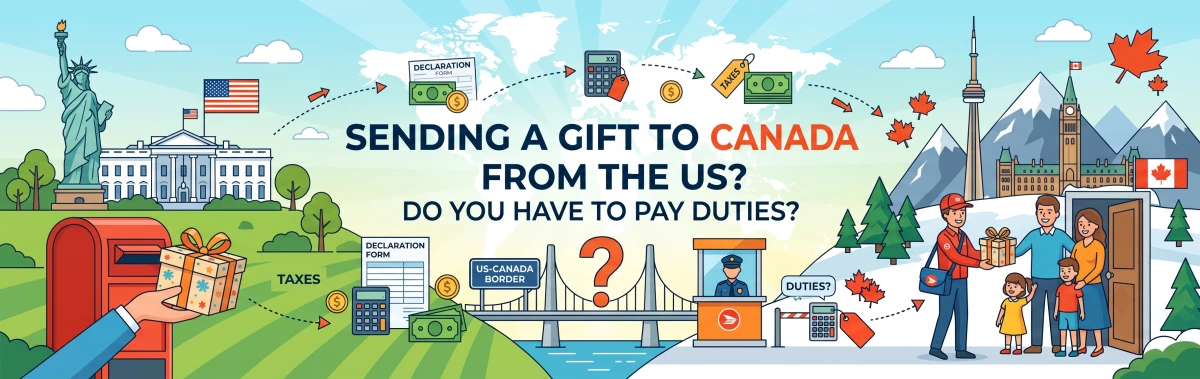
Sending a Gift to Canada from the US? Do You Have to Pay Duties?
Sending a gift across the border to a friend, family member, or business partner in Canada seems like it should be simple. You pick something thoughtful, wrap it up, drop it at a carrier, and expect it to arrive with the same ease as a domestic package. In reality, international shipping involves a few more moving parts, and one of the most common questions people ask is whether they need to pay duties when sending a gift to Canada. The short answer is that it depends on the value of the item, what it is, and how it is declared. In this article, we will walk through everything you need to know about duties, taxes, and the paperwork involved so your gift arrives smoothly and without unexpected fees.
Understanding Duties and Taxes on Gifts to Canada
Canada, like most countries, applies import duties and taxes to goods entering the country, including personal gifts sent from abroad. The Canada Border Services Agency (CBSA) is responsible for assessing these charges. While gifts are treated a bit more leniently than commercial shipments, they are not automatically exempt from all fees.
Canada offers a gift exemption for items sent by one individual to another, as long as certain conditions are met. If the gift is valued at CAD 60 or less and is clearly marked as a gift, it may qualify for duty and tax free entry. However, if the value exceeds that threshold, duties and the Goods and Services Tax (GST), along with any applicable provincial sales tax, will typically apply to the amount over the exemption limit, or in some cases to the full value of the item depending on how it is classified.
It is also worth noting that certain categories of goods, such as tobacco, alcohol, and advertising material, do not qualify for the gift exemption regardless of value. So if you are sending a bottle of wine or a box of cigars as a present, expect that duties and taxes will apply from the very first dollar.
What Determines Whether You Pay Duties
Several factors influence whether your gift will attract duties when it crosses into Canada.
The declared value of the item matters most. Anything under the CAD 60 exemption threshold, properly labeled as a gift, generally passes through without extra charges. Once you go above that amount, the CBSA will typically calculate duties based on the item's value, its country of origin, and its harmonized system classification code.
The type of product also plays a role. Electronics, clothing, and jewelry often carry different duty rates than books, toys, or handmade crafts. Some goods manufactured in the United States may qualify for reduced or zero duty rates under trade agreements such as the United States Mexico Canada Agreement, provided the proper origin documentation is included.
How the package is declared matters as well. Every international shipment requires a customs declaration form that lists the contents, their value, and the purpose of the shipment, such as gift, sale, or return. Accurate and honest declarations help avoid delays, and mislabeling an item as a gift when it is actually part of a business transaction can lead to penalties or seizure.
How to Ship to Canada Without the Headache
If you are new to cross border shipping, learning how to ship to Canada properly can save you time, money, and frustration. The process starts with choosing a reliable carrier that understands the customs requirements for both countries. From there, you will need accurate documentation, correct valuation, and clear labeling.
Start by weighing and measuring your package accurately, since shipping costs and duty assessments are often tied to these details. Next, fill out a customs declaration form with a truthful description of the contents and their value. Avoid the temptation to underdeclare value in hopes of dodging duties, as this practice, sometimes called undervaluing, is illegal and can result in fines or confiscation of the package.
Choose a shipping method that fits your timeline and budget. Standard postal services tend to be more affordable but slower, while express couriers offer faster delivery with more robust tracking and customs handling support. Many carriers, including private logistics companies, offer prepaid duty options so the recipient is not surprised with a bill at the door.
How to Send a Package to Canada Step by Step
Understanding how to send a package to Canada involves a few consistent steps regardless of which carrier you choose.
First, package your item securely using sturdy boxes and appropriate cushioning material, since international transit involves more handling than domestic shipping. Second, complete a customs form (commonly CN22 or CN23 for postal shipments, or a commercial invoice for courier shipments) that lists the item, its value, its origin, and its purpose. Third, decide whether you or the recipient will be responsible for any duties and taxes that may apply, and communicate this clearly since some carriers allow you to prepay these charges.
Fourth, attach the correct postage or shipping label and drop off the package with your chosen carrier or schedule a pickup. Finally, keep your tracking number and receipt so you can monitor the shipment and address any customs holds quickly if they arise. Following these steps consistently reduces the chance of delays at the border and ensures your recipient receives their gift without unnecessary complications.
Tips to Minimize Duties on Gifts
While you cannot eliminate duties entirely for higher-value items, there are ways to reduce the likelihood of unexpected charges. Keep the declared value accurate but be mindful of the CAD 60 exemption threshold when selecting a gift, since staying under this amount often means the recipient will not owe anything extra. Clearly write "gift" on the customs form and include a short note describing the occasion, as this helps customs officers process the shipment appropriately.
If you are sending several items at once, consider whether splitting them into separate shipments to different recipients makes sense, since the exemption generally applies per recipient rather than per shipment as a whole. Also, research whether the item you are sending qualifies for reduced duty rates due to its US origin, as many manufactured goods produced domestically may be eligible for preferential treatment under trade agreements.
Learning How to Ship from US to Canada for Different Occasions
Many people only think about cross border shipping during the holiday season, but gifts travel across the border year round for birthdays, weddings, graduations, and other celebrations. Knowing how to ship from US to Canada consistently, rather than figuring it out each time under time pressure, makes the process far less stressful.
Consider setting up an account with a shipping provider that specializes in cross border logistics. This allows you to save recipient addresses, reuse customs information, and access better rates for frequent shipments. It also helps to keep a simple checklist of information you need each time, such as recipient details, item description, declared value, and the purpose of the shipment, so you are not scrambling to gather this information at the last minute.
Common Mistakes to Avoid
A frequent mistake people make is assuming that because something is labeled a gift, it will automatically be duty free regardless of value. As covered earlier, the CAD 60 exemption only applies up to that threshold, and anything beyond it may still incur charges. Another mistake is providing vague descriptions on customs forms, such as writing "gift item" without specifying what it actually is, which can trigger delays or additional inspection.
Underestimating shipping timelines is another common issue. Cross border packages generally take longer than domestic ones due to customs processing, so it is wise to ship well ahead of the occasion you are celebrating. Finally, failing to include proper contact information for both the sender and recipient can cause a shipment to be held if customs officials need clarification.
Conclusion
Sending a gift to Canada from the US does not have to be complicated once you understand how duties, taxes, and customs declarations work. Items valued at CAD 60 or less and properly marked as gifts typically move across the border without extra fees, while higher value items may incur duties and taxes depending on their classification and origin. By declaring your shipment accurately, choosing the right carrier, and following the proper steps, you can ensure your gift reaches its recipient smoothly and on time.
If you want a stress free way to handle cross border shipping, Zion Shipping is here to help. Our team specializes in guiding customers through every step of sending packages and gifts to Canada, from accurate customs documentation to reliable, trackable delivery. Reach out to Zion Shipping today and let us take the guesswork out of your next cross border shipment.
Also Read: How Much Does It Really Cost to Ship From USA to Canada in 2026?
Frequently Asked Questions
1. Do I have to pay duties on every gift I send to Canada?
Not necessarily. Gifts valued at CAD 60 or less and clearly marked as a gift on the customs form are generally exempt from duties and taxes. Items above that value may be subject to duties and applicable taxes on the amount exceeding the exemption.
2. What items never qualify for the gift exemption?
Certain goods such as tobacco, alcohol, and advertising materials do not qualify for the gift exemption, even if their value is under CAD 60. Duties and taxes typically apply to these items regardless of value.
3. Who is responsible for paying duties, the sender or the recipient?
This depends on the shipping arrangement. Some carriers allow the sender to prepay duties and taxes, while in other cases the recipient in Canada is billed upon delivery. It is a good idea to clarify this with your carrier before shipping.
4. How long does it take for a package to clear Canadian customs?
Clearance times vary depending on the carrier, the completeness of the customs documentation, and the volume of shipments being processed. Straightforward, well documented gifts often clear within a day or two, while incomplete forms can cause longer delays.
5. Can I reduce the chance of my gift being held at customs?
Yes. Providing an accurate and specific description of the item, declaring a realistic value, clearly marking the shipment as a gift, and including complete sender and recipient information all help reduce the likelihood of your package being held for additional review.