
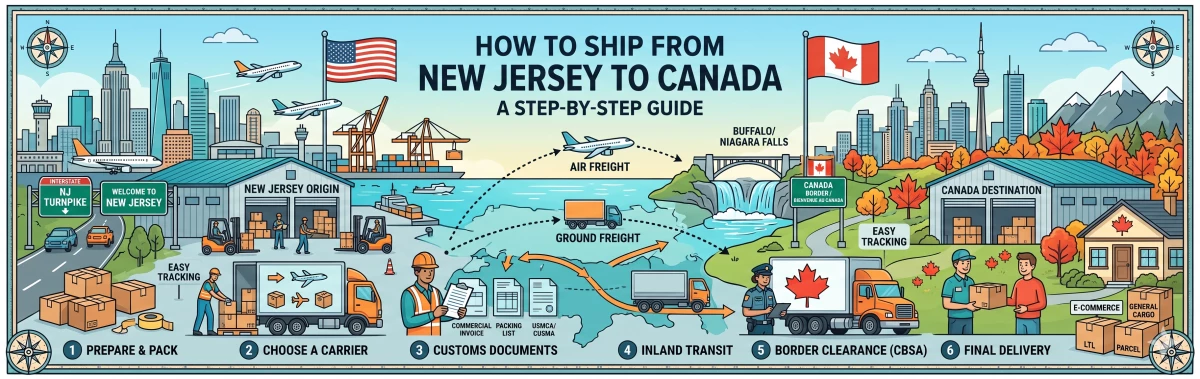
How to Ship from New Jersey to Canada: A Step-by-Step Guide
Sending a parcel, pallet, or entire household across the border can feel overwhelming at first. New Jersey sits in one of North America's busiest logistics corridors, with Newark's port and airport, major highways, and hundreds of carriers nearby. Canada, however, has its own customs rules, tax requirements, and paperwork. This guide walks you through every stage, from choosing a service to tracking your delivery, so your shipment arrives on time and without surprise fees.
Step 1: Define What You Are Sending
Before you request a single quote, get clear on the basics of your shipment. Carriers price based on weight, dimensions, value, and destination, so you need accurate numbers.
Write down the following:
1. The type of item (documents, retail goods, personal belongings, machinery, or furniture)
2. The total weight and the length, width, and height of each package
3. The declared value of everything inside
4. The exact pickup address in New Jersey and the full delivery address in Canada, including the postal code
5. Your preferred delivery date
Having these details ready speeds up quoting and prevents billing adjustments later, which happen when a carrier measures a package larger than you declared.
Step 2: Check What You Are Allowed to Send
Not everything can cross the border. Canada restricts or prohibits several categories, and sending one by mistake can lead to seized goods, fines, or long delays. Items that commonly raise problems include:
1. Firearms, ammunition, and certain weapons
2. Fireworks and explosives
3. Some food, plant, and animal products
4. Certain medications and supplements
5. Alcohol and tobacco, which need special permits and carry high taxes
6. Lithium batteries, which have strict packaging and labeling rules
If you are unsure about an item, check the Canada Border Services Agency website or ask your carrier before you pack. A quick question now costs far less than a held shipment later.
Step 3: Choose the Right Shipping Method
Your best option depends on speed, size, and budget. The main choices are:
Express courier. Companies like FedEx, UPS, and DHL offer fast door-to-door delivery, often within one to three business days. This works well for documents, small parcels, and urgent orders.
Standard postal service. USPS and Canada Post partner on cross-border delivery. It is usually cheaper for light packages, though transit times and tracking detail vary.
Ground freight. Less than truckload (LTL) suits pallets and heavier goods that share trailer space with other shipments. Full truckload (FTL) makes sense when your cargo fills most of a trailer. Transit from New Jersey to Ontario or Quebec typically takes a few days, while western provinces take longer.
Air freight. Best for high value or time-sensitive cargo. It is the fastest option for large shipments but also the most expensive.
Ocean freight. Containers can move through the Port of Newark toward Canadian ports. This is slower but economical for very large or heavy loads.
Step 4: Estimate Your Costs Before You Book
Budgeting is where many first-time shippers get caught off guard. Understanding shipping costs to Canada means looking beyond the carrier's base rate. Your final bill is usually shaped by these factors:
1. Actual weight versus dimensional weight, where carriers charge for the space a package takes up
2. Distance and delivery speed
3. Fuel surcharges and seasonal peak fees
4. Residential or remote area delivery fees
5. Insurance coverage
6. Customs brokerage fees
7. Canadian duties, GST, HST, or provincial taxes
Ask every carrier for an all-inclusive quote and confirm who pays duties and taxes. If the recipient pays on delivery, they may be surprised by a bill and refuse the package. If you pay in advance, using a delivered duty paid service gives your receiver a smooth experience.
Step 5: Prepare Your Customs Documents
Paperwork is the heart of any border crossing. Incomplete or inaccurate documents are the number one cause of delays. For most shipments you will need:
A commercial invoice. This lists the sender, receiver, item descriptions, quantity, unit value, and currency. Describe items clearly. "Cotton shirts" is better than "clothing samples."
Harmonized System (HS) codes. These numeric codes classify your goods and determine the duty rate.
Country of origin. Where the goods were made affects whether duty applies.
CUSMA certification. Many goods made in the United States qualify for reduced or zero duty under the Canada-United States-Mexico Agreement, but only if the origin rules are met and the certification is complete.
Permits or licenses. Regulated goods may need extra approval.
Personal gifts and household moves follow slightly different rules, but accuracy and honesty matter in every case. Never undervalue a shipment to dodge taxes, because customs officers can inspect and penalize mismatched declarations.
Step 6: Pack Your Items Correctly
Cross-border journeys involve more handling and more transfer points, so your packaging must be stronger than for a local delivery.
1. Use new, sturdy boxes or crates rated for the weight of your items.
2. Fill empty space with cushioning such as bubble wrap, foam, or packing paper.
3. Seal seams with strong tape using the H pattern.
4. Wrap and stretch-wrap pallets, and use corner boards for stability.
5. Place a shipping label on the outside and a duplicate inside the package.
6. Keep fragile or high-value items in double boxes.
Photograph your items and packaging before pickup. These images are valuable if you ever need to file an insurance claim.
Step 7: Compare Carriers and Book Your Shipment
Now that you know your weight, route, documents, and budget, request quotes from at least three providers. Compare more than price. Look at transit time, tracking quality, insurance terms, customs support, and customer reviews.
Working with a carrier or freight forwarder that has experience with shipping from the United States to Canada makes a big difference. They know which forms are required, which border crossings are fastest, and how to resolve problems quickly if your shipment is flagged. Once you choose a provider, confirm the pickup window, print your labels, and hand over all documents.
Step 8: Track Your Shipment Through Customs and Delivery
After pickup, your package moves through a New Jersey terminal, crosses the border, and enters Canadian customs. A broker or the carrier submits your information electronically. If everything is correct, clearance can take only hours. If something is missing, the shipment may be held until you provide it.
Stay proactive:
1. Monitor tracking updates daily.
2. Keep your phone and email available in case customs has questions.
3. Notify the recipient so they can expect delivery and any tax payment.
4. Inspect the package on arrival and report damage immediately, noting it on the delivery receipt.
Special Case: Moving Large Items and Furniture
Bulky goods require a different approach than standard parcels. If you are shipping furniture from US to Canada, consider disassembling pieces, protecting corners and surfaces with moving blankets, and wrapping upholstery in plastic to guard against moisture. Large items typically travel by LTL freight or with a household goods mover, and you will need an itemized inventory with values for customs. Wooden crates and pallets must also meet international phytosanitary standards, which usually means heat treated and stamped wood. Ask your carrier about these details early so nothing delays your move.
Common Mistakes to Avoid
Even experienced shippers slip up. Watch out for these frequent errors:
1. Using vague item descriptions on the invoice
2. Guessing at weights and dimensions
3. Skipping insurance on valuable items
4. Ignoring taxes and duties in the budget
5. Choosing a carrier based only on the lowest price
6. Waiting until the last minute to gather documents
Ready to Send Your Shipment? Choose the Cheapest Shipping Company in New Jersey
Shipping across the border does not have to be stressful or expensive. With the right partner, you get low rates, clear pricing, expert customs support, and reliable delivery to every Canadian province.
Get a free quote today from the Cheapest Shipping Company in New Jersey. Tell us what you are sending, and we will give you a transparent, all-inclusive price with no hidden fees. Whether you are sending a single box, a pallet, or a full container, our team handles pickup, paperwork, and delivery for you.
Contact us now and start saving on your next Canada shipment.
Also Read: How to Buy From American Stores and Get It Delivered to Canada (Without the Headaches)
Frequently Asked Questions
1. How long does delivery from New Jersey to Canada usually take?
Express services typically deliver in one to three business days. Standard ground shipping often takes three to seven days depending on the province, while freight and ocean options can take longer.
2. Will I have to pay duties and taxes on my shipment?
Often yes. Canada may charge duties, GST, HST, or provincial sales tax based on the value, type, and origin of the goods. Some US-made products qualify for reduced or zero duty under CUSMA.
3. Do I need a customs broker?
It is not always required for small parcels, since many couriers handle clearance for you. For commercial freight, high-value goods, or regulated items, a licensed customs broker helps prevent delays and errors.
4. Can I insure my package?
Yes. Most carriers offer declared value coverage, and independent insurers offer additional protection. Insurance is strongly recommended for electronics, furniture, and anything fragile or valuable.
5. What happens if my shipment is held at customs?
Customs will usually contact the carrier, broker, or recipient to request missing information or payment. Responding quickly with accurate documents is the fastest way to release the goods.