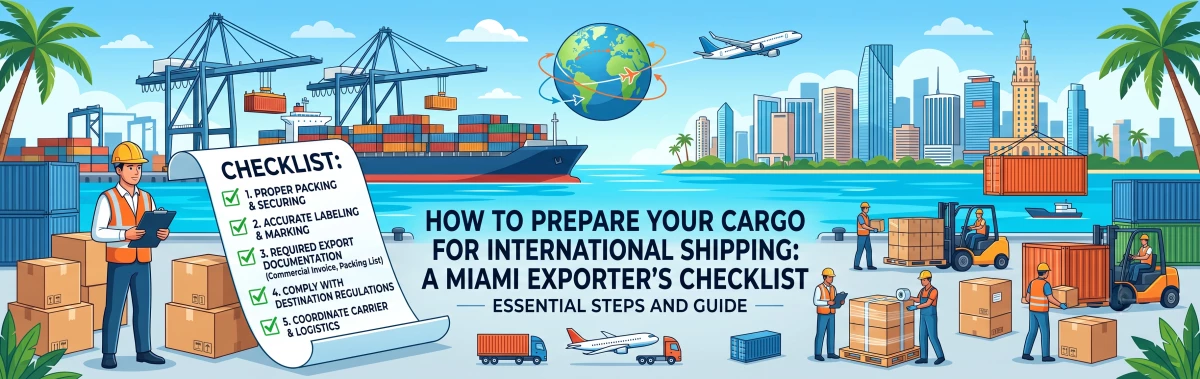
How to Prepare Your Cargo for International Shipping: A Miami Exporter's Checklist
Shipping cargo internationally from Miami puts your business in a unique position. As one of the busiest logistics hubs in the country, Miami connects exporters to Latin America, the Caribbean, Europe, and beyond. But that advantage only pays off if your cargo is properly prepared before it ever reaches the port. Errors in documentation, packaging, or compliance can lead to costly delays, fines, or even seized shipments.
This guide walks through a practical checklist that Miami exporters, whether new to the process or seasoned professionals, can use to prepare cargo for smooth international transit.
Why Preparation Matters More Than You Think
Every year, businesses lose thousands of dollars because of preventable shipping mistakes. Missing paperwork, incorrect labeling, or improperly packed goods account for a large share of customs holds and damaged freight claims. Having worked alongside logistics teams and exporters across South Florida, one truth becomes clear quickly: the businesses that treat preparation as a formality are the ones that end up with the most headaches.
Preparation is not just about avoiding problems. It is about protecting your reputation with international buyers, meeting delivery deadlines, and controlling costs that can spiral out of hand when shipments are delayed at customs.
Step 1: Know Your Product Classification
Before anything else, determine the correct Harmonized System (HS) code for your product. This code determines duty rates, import restrictions, and whether your goods require special permits. Misclassifying a product, even unintentionally, can trigger fines or shipment holds.
Practical tip: Work with a licensed customs broker or freight forwarder to confirm classification, especially for products that could fall under multiple categories such as electronics, chemicals, or food items.
Step 2: Gather the Right Documentation
Proper documentation is the backbone of any successful export. At minimum, most shipments require:
Commercial invoice detailing the value, description, and quantity of goods
Packing list outlining how the cargo is packed and organized
Bill of lading or airway bill depending on the mode of transport
Certificate of origin, particularly important for trade agreements
Export license, if your product falls under regulated categories
Every document should match exactly. A common issue exporters run into is inconsistent quantities or values listed across different forms, which raises red flags during customs review.
Step 3: Choose the Right Packaging for Your Cargo
Packaging is not one size fits all. Cargo traveling by ocean freight faces different conditions than cargo traveling by air. Moisture, temperature swings, vibration, and stacking pressure all affect how goods should be packed.
For fragile or valuable items, use reinforced crating and moisture barriers. For palletized freight, confirm that pallets meet ISPM 15 standards, which require heat treated or fumigated wood to prevent the spread of pests across borders. Failing this standard alone can result in a shipment being rejected at the destination port.
Step 4: Label Cargo Correctly
Labels should include the shipper and consignee information, destination country, handling instructions, and any hazard symbols if applicable. Labels should be printed clearly and placed in a location that remains visible even if boxes shift during transit.
For hazardous materials, labeling must follow International Maritime Dangerous Goods (IMDG) or International Air Transport Association (IATA) regulations depending on the shipping method. Getting this wrong is not just a compliance issue. It is a safety issue that can affect everyone involved in handling your freight.
Step 5: Understand Incoterms Before You Ship
Incoterms define who is responsible for costs and risks at each stage of the shipment. Terms like FOB (Free on Board), CIF (Cost, Insurance, and Freight), and DDP (Delivered Duty Paid) determine whether the seller or buyer handles freight charges, insurance, and customs clearance.
Choosing the wrong Incoterm can create confusion about who pays for what, especially when disputes arise mid shipment. Clarify these terms with your buyer before finalizing any contract.
Step 6: Verify Compliance With Destination Country Regulations
Every country has its own import regulations. Some require specific certifications for food, cosmetics, or electronics. Others impose strict limits on certain materials or require pre-approval before goods even leave the origin port.
Research the regulatory requirements of your destination country well in advance. Waiting until the cargo is already in transit to discover an issue can lead to expensive storage fees or the goods being returned entirely.
Step 7: Insure Your Shipment
Cargo insurance protects your business financially in case of loss, theft, or damage during transit. While ocean and air carriers offer limited liability coverage, it rarely reflects the full value of your goods. Purchasing separate marine cargo insurance ensures your business is not left absorbing the full loss if something goes wrong.
Step 8: Partner With a Reliable Logistics Provider
Working with an experienced logistics partner can make the difference between a smooth shipment and a frustrating one. A knowledgeable provider will help with International Shipping from Miami, guide you through customs procedures, recommend the right carrier for your cargo type, and flag potential compliance issues before they become expensive problems.
This is particularly valuable for businesses new to exporting, as regulations and requirements can change frequently depending on trade agreements and global events.
Step 9: Track Your Shipment From Start to Finish
Once your cargo leaves Miami, visibility matters. Choose a provider that offers tracking so you know exactly where your shipment is at every stage. This is especially important for time sensitive goods or shipments tied to contractual deadlines with international buyers.
Many providers now offer international courier delivery options for smaller, time critical shipments that need to move faster than standard freight, giving exporters flexibility depending on cargo size and urgency.
Step 10: Prepare for Customs Clearance on Both Ends
Customs clearance can be one of the most unpredictable parts of international shipping. Delays often happen not because of major issues, but because of small inconsistencies in paperwork or missing signatures. Double check every form before submission, and keep copies of everything in case questions arise after the shipment has already left port.
A Quick Reference Checklist
- Confirm HS code classification
- Prepare commercial invoice, packing list, and bill of lading
- Verify certificate of origin and export license if required
- Package cargo appropriately for its mode of transport
- Use ISPM 15-compliant pallets for wood packaging
- Label cargo clearly with all required information
- Agree on Incoterms with your buyer
- Research destination country import regulations
- Purchase adequate cargo insurance
- Work with a trusted logistics partner offering reliable international shipping services
- Track your shipment through to delivery
- Double-check all customs documentation before departure
Conclusion
Preparing cargo for international shipping takes attention to detail, but it does not have to be overwhelming. By following a structured checklist, Miami exporters can avoid common pitfalls, reduce delays, and build stronger trust with international buyers. Preparation today saves time, money, and stress once your cargo is already on its way.
If you are ready to ship with confidence, Zion Shipping is here to help. Our team supports Miami exporters at every step, from documentation and packaging guidance to customs clearance and delivery tracking. Reach out to Zion Shipping today to get your next shipment moving smoothly and on schedule.
Also Read: USPS vs FedEx vs UPS vs DHL: Best Option for Shipping to Canada
Frequently Asked Questions
Q1. What documents are required for international shipping from Miami?
Most shipments require a commercial invoice, packing list, bill of lading or air waybill, certificate of origin, and an export license if the goods are regulated. Requirements can vary by destination country, so confirming specifics ahead of time helps avoid delays.
Q2. How do I know if my cargo needs special packaging?
Cargo type, mode of transport, and destination climate all affect packaging needs. Fragile, perishable, or hazardous goods typically require specialized crating, moisture protection, or temperature-controlled containers to arrive safely.
Q3. What happens if my shipment is missing paperwork at customs?
Missing or inconsistent documentation can result in customs holds, storage fees, fines, or the shipment being returned to origin. Reviewing all paperwork for accuracy before departure significantly reduces this risk.
Q4. How far in advance should I prepare cargo for export?
Ideally, preparation should begin several weeks before shipping, especially for cargo requiring permits, certifications, or specialized packaging. This allows enough time to resolve any compliance issues without delaying the shipment.
Q5. Do I need cargo insurance if my carrier already offers coverage?
Carrier liability coverage is usually limited and may not reflect the full value of your goods. Separate marine cargo insurance offers broader protection and ensures your business is financially covered in case of loss or damage.