How Long Does It Take to Get to Brazil from Major U.S. Cities?
Planning a trip, a move, or an international shipment often starts with one simple question: how long does it take to get to Brazil from the United States? The answer depends on where you are starting, how you are traveling, and whether you are talking about passengers, packages, or freight. Brazil is a large country with major entry points on both the coast and inland regions, so transit time can vary quite a bit from one U.S. city to another.
For travelers, the total journey usually includes both flight time and layover time. For shippers, the timeline depends on the service level, customs clearance, and the final destination within Brazil. A direct flight from Miami to São Paulo is very different from a shipment leaving from Seattle and moving through multiple handling points before it reaches Rio de Janeiro, Brasília, or Recife.
This guide breaks down average travel times from major U.S. cities, explains what affects transit time, and helps you understand how to plan more efficiently whether you are flying personally or arranging international cargo.
Understanding Travel Time to Brazil
Brazil is one of the largest countries in the world, so “getting to Brazil” is not the same as reaching one single place. Someone heading to São Paulo, for example, may arrive much faster than someone whose final destination is a smaller inland city that requires an additional domestic connection. The same idea applies to shipping. A package may land in a major Brazilian port or airport quickly, but the last leg to the recipient can add days.
When people search for shipping us to brazil, they are often trying to understand whether the process will take a few days or several weeks. The truth is that transit time depends on the route, the carrier, the customs process, and whether the item is moving by air or ocean. Air is usually faster, while sea freight is better for larger and heavier shipments.
For passengers, nonstop flights are the fastest option, but not every U.S. city offers them. Many travelers connect through Miami, Atlanta, Dallas, New York, or Houston before continuing to Brazil. That means total travel time can increase even if the destination itself is far from the origin.
From Miami to Brazil
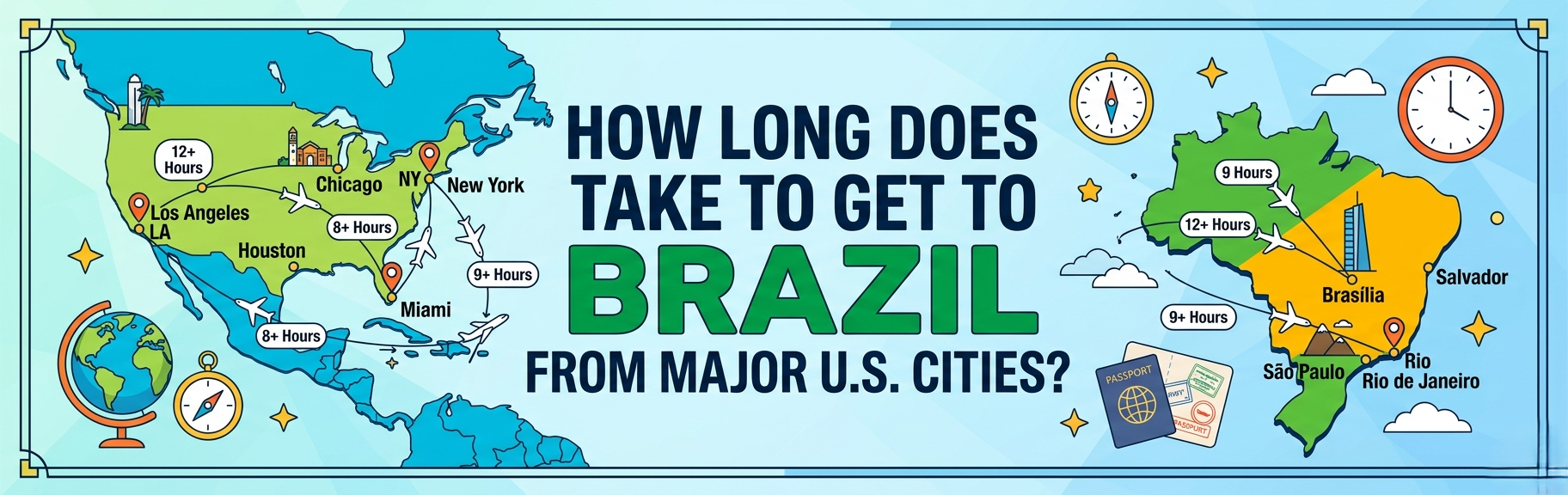
Miami is one of the most common departure points for Brazil-bound travel because of its strong international flight network and geographic advantage. A direct flight from Miami to São Paulo often takes around eight to nine hours, while flights to Rio de Janeiro are usually similar. If you are flying to northeastern Brazilian cities like Recife or Salvador, total time may be slightly shorter or longer depending on the route.
For cargo, Miami also plays an important role because many U.S. exporters use it as a gateway for Latin America. When people ask about shipping from us to brazil, Miami is often one of the first cities that comes up. Air freight from Miami can move quickly, sometimes within a few business days, while ocean freight may take significantly longer.
Miami is especially useful for urgent shipments because it reduces domestic transit within the U.S. before the package even leaves the country. That can make a real difference when the goal is speed.
From New York to Brazil
New York is another major hub for Brazil travel. Direct flights from New York to São Paulo usually take around ten hours, and flights to Rio de Janeiro are often in the same range. Because New York is farther north than Miami, the travel time is typically longer, but the city still offers strong international connectivity and multiple airline options.
For shipments, New York is often selected for high-value or time-sensitive cargo because of its logistics infrastructure. Air freight from New York to Brazil can be efficient, especially when customs paperwork is complete and the shipment is handled through a reliable carrier.
When comparing brazil shipping usa, New York often appears in the discussion because it has access to major airports, cargo centers, and international handling networks. This makes it a practical origin point for both personal and business shipments to Brazil.
From Los Angeles to Brazil
Los Angeles is much farther from Brazil than East Coast cities, so the total journey is usually longer. Flights from Los Angeles to São Paulo or Rio de Janeiro generally require at least one stop and can take well over 13 hours total travel time, sometimes more depending on the layover. The same is true for cargo. A shipment leaving the West Coast may need extra routing before it reaches a Brazilian gateway.
That does not mean Los Angeles is a poor origin point. It simply means planning is more important. Travelers should expect a long-haul journey, and shippers should allow additional time for routing, handling, and customs. For large commercial shipments, the West Coast can still be efficient, especially when ocean freight is part of a broader supply chain strategy.
From Houston to Brazil
Houston has become an important logistics center for international cargo and passenger travel. Flights to Brazil from Houston are often efficient because of the city’s strong airline presence and its central location in the southern United States. Depending on the destination in Brazil, direct or one-stop flights may be available.
For freight, Houston can be very effective for industrial, commercial, and heavy shipments. Businesses often look at Houston when they need reliable international movement with good air or sea access. The overall shipping duration to Brazil can vary, but Houston is frequently a practical middle ground between speed and cost.
From Atlanta to Brazil
Atlanta is one of the busiest aviation hubs in the world, so it naturally plays a major role in travel to South America. Flights from Atlanta to Brazil are often competitive in both availability and duration. If a direct flight is available, it can be relatively efficient. If not, the city still offers strong connecting options.
For international logistics, Atlanta is also a useful origin point because of its central U.S. location and excellent freight infrastructure. Air shipments from Atlanta to Brazil can move quickly when all documents are ready. Because it is not a coastal city, some logistics paths may take a little longer than Miami, but the overall network remains strong.
From Chicago to Brazil
Chicago is farther north and often requires a connection for Brazil-bound travel. As a result, total flight time usually stretches beyond the nonstop timing you might see from southern U.S. cities. Depending on the route, the overall journey may land somewhere between 11 and 15 hours or more.
Cargo from Chicago follows a similar pattern. It can move efficiently through major air and ground networks, but extra inland distance from a Brazilian gateway can add time. Chicago is still a strong origin point for shipments because of its central logistics role in the United States.
From Dallas to Brazil
Dallas is another major U.S. hub for Latin America travel and shipping. It offers strong airline connectivity and is often a reliable choice for Brazil travel with one stop or sometimes direct routes depending on the season and airline schedules. Travel time from Dallas can be competitive, especially for destinations in southeastern Brazil.
For freight, Dallas is useful because it combines a centralized domestic reach with a strong international infrastructure. Businesses arranging shipping from us to brazil often consider Dallas because it can offer a balance between transit speed and broad service availability.
What Affects Travel and Shipping Time
Several factors influence how quickly someone or something reaches Brazil. Distance is only part of the picture. Flight availability, airline schedules, customs processing, weather, documentation, and route efficiency all play a role.
For travelers, layover duration is one of the biggest variables. A route that looks short on paper may become a much longer journey if the connection is five or six hours. For cargo, paperwork is often the biggest cause of delay. Missing invoices, incomplete declarations, restricted items, or incorrect labels can hold up a shipment even when the flight or vessel arrives on time.
The type of service also matters. Express air services are faster but more expensive. Standard air services are moderately fast and more affordable. Ocean freight is the slowest, but it is often the best choice for large, heavy, or non-urgent cargo.
Seasonality can also affect timelines. Around holidays or peak shipping periods, airlines and freight networks become more crowded, and customs can take longer. Planning ahead is always the safer approach.
Air Freight Versus Ocean Freight
If speed is the top priority, air freight is usually the best option. It is ideal for urgent documents, electronics, clothing, small commercial items, and shipments with a tight deadline. Most air freight to Brazil moves much faster than sea freight, though it is also priced higher.
Ocean freight is better for large-volume cargo, furniture, household goods, and business inventory. It usually takes far longer, but it can significantly reduce cost per unit. For many companies, the slower transit time is worth it because the savings are substantial.
People comparing how long does it take to get to brazil often discover that the real answer depends on whether they want the fastest possible route or the most economical one. Air gets there sooner. Sea gets there cheaper. The right choice depends on the shipment and the urgency.
Planning Ahead for a Smooth Journey
Whether you are traveling or shipping, advance planning helps avoid unnecessary delays. Travelers should confirm passport validity, visa requirements if applicable, airline baggage rules, and connection times. Shippers should make sure invoices, packing lists, receiver details, and customs documents are accurate before departure.
A well-prepared shipment usually moves faster through both U.S. export procedures and Brazilian import clearance. A poorly prepared one can sit in transit much longer than expected. Even when the transport time is short, customs can extend the total delivery timeline.
This is why choosing the right logistics partner matters. A reliable provider can help you select the best route, explain service options, and reduce the risk of delays.
Why Brazil Is a Unique Destination
Brazil’s size makes it a unique travel and shipping destination. A shipment to São Paulo does not necessarily follow the same timing as one going to Manaus, Fortaleza, or Porto Alegre. The country’s geography means that internal distribution can add extra days, especially when the final destination is far from the main international gateway.
That is also why estimates should always be considered carefully. A package may arrive in Brazil in a few days, but final delivery might take longer. A direct flight may land quickly, but the full trip still includes airport procedures, baggage handling, and transfers.
Shipping from Brazil
Need a dependable way to move cargo between the United States and Brazil? Shipping from Brazil should feel straightforward, transparent, and efficient. Whether you are sending personal goods, business inventory, or time-sensitive freight, choosing a service that understands international logistics can save time and reduce stress. Reach out today to plan the best route, compare delivery timelines, and get support for a smoother shipping experience from start to finish.
Conclusion
Travel and shipping times to Brazil vary by city, route, and service type. Miami and other southern U.S. hubs often offer the fastest access, while West Coast and northern cities usually involve longer flight times or more complex freight routing. Customs, layovers, documentation, and final destination all influence the total timeline.
For travelers, the fastest path is usually a direct flight from a major hub. For shippers, air freight is the quickest option, while ocean freight is better for large or non-urgent cargo. Once you understand the difference between transport time and total delivery time, planning becomes much easier and more accurate.
Also Read: How Long Does Shipping from the US to Brazil Really Take?
FAQs
1. How long does it usually take to fly from major U.S. cities to Brazil?
From cities like Miami, flights can take around 8 to 10 hours depending on the destination. From cities farther away such as Los Angeles or Chicago, total travel time is usually longer, especially if a connection is required.
2. Does shipping to Brazil take longer than flying there as a passenger?
Yes, shipping generally takes longer because it involves freight handling, customs clearance, and final delivery. Air cargo is faster than ocean cargo, but both usually take more time than passenger travel.
3. What is the fastest way to send goods to Brazil?
Air freight is usually the fastest option for international shipments. It works well for smaller, urgent, or high-value items that need quicker delivery.
4. Why do shipping times to Brazil vary so much?
Timing varies because of distance, route selection, customs procedures, and whether the final destination is in a major city or a more remote area. Document accuracy also plays a big role in avoiding delays.
5. Can customs delay a shipment even after it reaches Brazil?
Yes, customs can delay a shipment if paperwork is missing, incorrect, or if the shipment requires extra inspection. Proper documentation helps reduce this risk and keeps the process moving more smoothly.